Kishore, Pai, Pande, Kanjilal, Singh, Singh, & Ram | 2025 About the Event As the world is moving towards a...
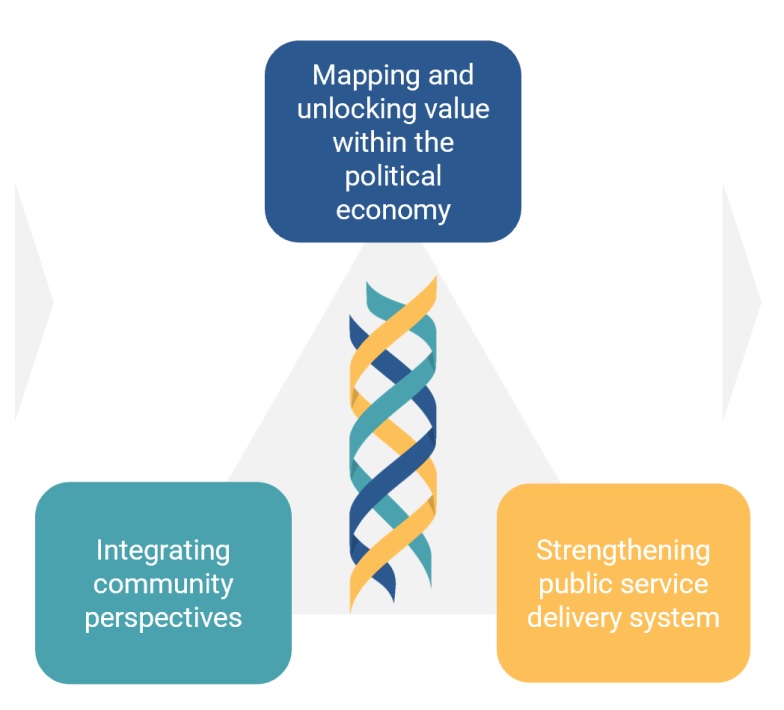
At Swaniti, we have a deep understanding of how to leverage political economy to drive scalable and long-term change in energy transition. Working globally, we operate at the intersection of climate, governance and community to prompt action, unlock critical resources, and build agency amongst local stakeholders.
Our work is rooted in improving the lives of the most vulnerable and disadvantaged through a systemic approach.
We embed team members within communities to align local aspirations with government resources, ensuring targeted and effective solutions.
We collaborate with communities and key government agencies to develop practical solutions for a sustainable energy transition.
We build consortiums consisting of experts, industries and civil society partners to drive coordinated and impactful action
We work closely with stakeholders to evaluate the scale and effectiveness of our initiatives, ensuring measurable progress on the ground.

Kishore, Pai, Pande, Kanjilal, Singh, Singh, & Ram | 2025 About the Event As the world is moving towards a...


Deeksha Pande, Sandeep Pai, Rishi Kishore, Sriram Kolasani, Sai Chandra R | December 2024 About the Event As the world...
Building Systems for an Inclusive Energy Transition
At Swaniti, we believe that tackling climate change requires more than just bold targets… it demands systems that works for everyone, especially those most vulnerable to its impacts
We understand that climate change is not a future possibility – it is a present crisis, and its consequences are not evenly distributed. Communities in the Global South, particularly those already living on the margins, are bearing the brunt of an accelerating climate emergency.
From coal miners facing issues with just transition, to industries struggling to access green finances, and farmers experiencing low yields due to erratic weather, all of these are deepening existing vulnerabilities and testing the resilience of governance systems.
Strong network and access to key stakeholders, including
government, SoEs, private sector and civil society
Technical knowledge, research and expertise on public service delivery systems
Deep understanding of the needs the last-mile beneficiaries and stakeholders
Planning & orchestration of
multi-stakeholder engagements
Increase in:
• Uptake of government schemes
• Funds unlocked
• Funds influenced / earmarked
Last mile centric approaches
leading to:
• Access to services
• Income generation /
augmentation
Governance and civic
participation
e Gender & social equity
While national and international commitments to clean energy and net-zero goals are growing, implementation often falters on the ground because:
This is where Swaniti begins its work. We start by engaging with those who are most affected – local leaders, frontline workers, and community members. Their insights are not supplementary; they are central. Our first steps involve:
These insights inform a deeper understanding of what climate equity should look like on the ground.
We bring out solutions from within communities—By building a collaborative ecosystem that unlocks public funds and resources and combines it with local partners and community leaders we build out sustainable solutions.
Then comes the implementation. Our technical teams work closely with sub-national governments. We are embedded within departments to support real-time planning, problem-solving and implementation. From enabling solar deployment and improving climate finance access, to integrating resilience planning and building local data systems. we help convert intent into impact.
For us, climate action is not just about reducing emissions; it’s about building institutional capacity (unlocking public funds and resources), empowering communities (bringing change through increased representation), and enabling transformation (enabling action from key stakeholders) that reaches the last mile.
Swaniti operates across 12 states, strengthening government programs and facilitating a green energy transition for state-owned enterprises. Our work ensures sustainable development and inclusive growth at the sub-national level.
We engage in micro-planning programs across the mining belt, advancing energy transition initiatives that promote sustainable mining practices, economic diversification, and social inclusion. Additionally, we work with industry leaders to drive methane mitigation and sustainable extraction methods in the fossil fuel sector, contributing to a cleaner and more responsible energy transition.
Through a strategic partnership with Bappenas (Ministry of Planning), we actively support energy transition and decarbonization efforts. Our work focuses on policy development, capacity building, and implementing sustainable energy solutions.
We collaborate with energy communities to identify and develop new economic opportunities as part of the energy transition. By supporting local stakeholders, we help ensure long-term resilience in shifting energy landscapes.
We collaborate with state government bodies to establish responsible mining practices, ensuring resource extraction aligns with environmental standards, community well-being, and long-term economic benefits. Our efforts contribute to a more resilient global supply chain. Based on Brazil’s model, we are also building a cross-state partnership on programs.
Working with government bodies, we promote sustainable mining practices that balance economic progress with environmental responsibility. We aim to transform Nigeria’s resource sector into a model for sustainable development.